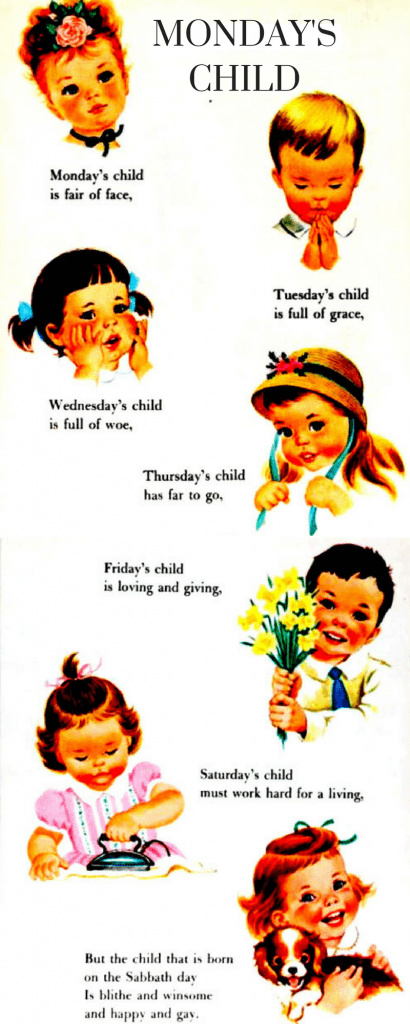
As early as the 1500s, there was a tradition of using the day of a child’s birth to foretell their character. “Monday’s Child” is a well-known nursery rhyme from around 1838 that served that purpose and also helped young children remember the days of the week.
The rhyme has been used as a starting point for novels, ballets, record albums, television shows, short stories, classical compositions, pop music, and more. The cabaret band, Vermillion Lies, who were together for only three brief years from 2006-2009, recorded a tune (Wednesday’s Child) that includes the complete text of the verse. Their additional lyrics express frustration for being born a woeful child on a Wednesday, jealous of the winsome and blithe child of Sunday. The recording begins and ends with the complete poem accompanied by a toy piano.
Something brought this rhyme to mind recently, and I was secretly hoping that I was born on a Tuesday, so that I could be a child full of grace. I looked up what day of the week I came into this world, and was dismayed to find that I, too, was a Wednesday’s child, full of woe. Obviously, this method of fortune-telling is inaccurate at best, but I was still disappointed.
 Being a child of grace seemed more beautiful and valuable. I could do so much in the world as a child of grace, rather than as a child of woe. Grace is from the Latin word, gratia or gratus, which means thankful, pleasing, grateful and agreeable. In Christianity, grace is described as unmerited favor. I could be a thankful, agreeable child with more than enough unmerited favor to pass on to others.
But I was born a child of woe. No matter how much I wished I was a Tuesday’s child full of grace, I fit perfectly as a woeful Wednesday’s child. Woe is a Germanic exclamation of lament and means great sorrow or distress. I was always a moody, difficult child, experiencing a typical amount of sorrow and distress, and the past several years have been filled with more than enough confusion, tears, and pain.
I just entered a new half-century, turning 50 a few weeks ago. I decided that I would hit reset on my journey as I reached this milestone. I thought to myself, “I can become a Tuesday’s child full of grace. My day of birth and a poem cannot dictate my future.” And wouldn’t you know it, my birthday this year fell on a Tuesday. I could begin again as Tuesday’s child, recasting my future with grace as my defining characteristic!
Since I enjoy learning, I spent a bit of time digging deeper into this rhyme and the various descriptions of the children. What I found made me unsure if I needed to change my original designation as a Wednesday’s child at all. On famlii.com, I found various interpretations and meanings for the poem. They explained that the child of woe is associated with emotional empathy. “They feel the weight of the world, with a caring and compassionate outlook, often to the point of sadness for others.”
Now I had a dilemma: “Do I stick with my original designation as a Child of Woe? Or do I claim my second half-century title of Child of Grace?”
Maybe there’s the option to be both since it’s only a poem, and I have many choices to make on living out my story.
Maybe my moments of sorrow and distress can empower my empathy with compassion, to share the weight of others’ sadness.
Maybe my fresh start can bring grace and acceptance to those around me through my honesty and vulnerability.
Maybe I can bring the insight and concern of Wednesday’s woeful child together with the welcome and benevolence of Tuesday’s graceful child in a way that deepens the power and value of each.
Today is a turning point. I can feel something is coming. I can’t put my finger on it, but it seems so tangible I can almost touch it. 


You must be logged in to post a comment.