So, I’m going to put it out there and say, I don’t believe that a person’s gender is separate 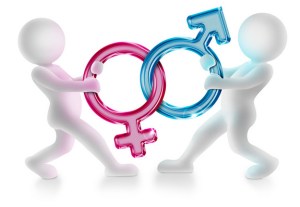 from their sex.
Latin – genus (birth, family, nation) →
Old French – gendre / genre →
Late Middle English – gender
The earliest meanings were kind, sort, genus
Latin – sexus from secus, root sec- (division, segment, cut) →
Old French sexe →
Late Middle English – sex
Denoting the two main categories (male and female) into which humans and many other living things are divided on the basis of their reproductive functions.
I mean no offense to those who believe otherwise. It’s just important to me to look at word meanings and histories and the concepts they represent.
The original meaning of the word gender was to classify things in like groups. So it does make sense as a word that identifies something or someone as part of a group. The words male and female denote groups that are separated by their biology and biological functions. So choosing to identify as one or the other despite biologically being classified as the opposite doesn’t seem to make sense. The very words male and female refer to a creature’s biological sex. So then choosing to use male or female as a gender identity changes the very meaning of those words which are biological classifications.
However, I do believe that all the baggage associated with being male or female and the roles, customs, clothing, and societal expectations that go with each should be challenged and questioned. If you wanted to use gender to refer to masculinity and femininity and identify as masculine or feminine, maybe that would make more sense. There are certainly masculine women, and feminine men, and most of us present a variety of both masculine and feminine traits. There is (and should be, in my estimation) a spectrum of gendered behaviors and choices in each of us. Balance here is valuable.
In the Oxford English Dictionary, gender is defined as, “in modern (especially) feminist use, a euphemism for the sex of a human being, often intended to emphasize the social and cultural, as opposed to the biological, distinctions between the sexes.”, with the earliest example cited being from 1963.
If gender refers to the social and cultural differences between men and women, while sex refers to biological and chromosomal differences, why don’t we challenge the social and cultural differences while embracing our biological sex? If innate maleness and femaleness are biological, and therefore immutable at a chromosomal level, why do we promote changing bodies to represent what we cannot actually be? While one may be able to identify as male or female, adapt their social and cultural choices, even adapt their bodies chemically and surgically to match that identity, and “pass” as that sex all while remaining biologically the opposite, the identity does not change the biology.
In a culture that is trying to teach girls to accept their bodies whether they are thin or heavy, why are we not trying to encourage all people to accept their bodies as a gift and a part of who they are? Why isn’t the answer instead to change the social and cultural expectations associated with gender by being who you are – both body and mind. Actually embracing the body and the mind and encouraging someone to accept themselves as they are.
I believe that your sex – biological, chromosomal sex – is unchangeable and present at birth.
(Yes, there is a very small percentage of people who have physical intersex conditions and it is not to those persons to which I refer. That is a separate topic worthy of its own conversation.)
I believe how you see yourself, how you perceive yourself, how you feel about yourself, how you present yourself, is fluid and not a permanent identifying feature. It does not carry immutability. Gender, if it refers to male and female, is immutable because male and female are biological classifications. Gender, if it refers to masculine and feminine, or if it refers to cultural and societal distinctions between men and women, is something that is changeable and can be chosen or reversed. Even if there is a genetic propensity towards gender difference, there is some choice in how to accept oneself or express that difference. It can be an identifying feature just like I identify as an extreme person or as a member of a certain political party. But it is not an immutable identification like your race or skin color or biological sex.
I think we should promote a broader acceptance of all people and the spectrum of gender expression by embracing atypical representations of male and female and functioning outside of cultural and societal expectations. Hopefully we can change those expectations to match 21st century ideas and sensibilities without losing respect for the biological package in which that gender atypical person resides – no chemical or surgical intervention required.
I love people – all people. No matter who you are, where you’re from, what you look like, what your experiences have been, how you feel about yourself, how you feel about me, whatever your political affiliation, how you like to dress, what you believe about God, and even if you identify as transgender, no matter what – I love people. I just want to make sure everyone has all their options open and that we think deeply and critically through the possibilities. I care too much to just accept prevailing winds without digging for all the truth that can be found.


You must be logged in to post a comment.