
In talking with our second twin about their choices concerning gender, I asked the question, “What do you believe is true?”
The postmodern view is that, “All truth is relative.” That’s the idea that something is true for one person but not true for another, relative to their frame of reference, language, culture, and so on, and that there is no absolute truth. Something can be true for you, and something different can be true for me. It’s all in how you see it or what you believe.
Absolute truth is defined as something that is true at all times and in all places no matter what the circumstances. For example, there are no round squares, it doesn’t matter your frame of reference. Or, all people living on earth are under the law of gravity. You don’t need to believe it in order for it to be true.
I believe that there are some absolute truths, but distinguishing between a provable, absolute truth, and a belief that something is an absolute truth, can be the more difficult process.
When it comes to gender dysphoria and transgenderism, some people think there is absolute truth which can be found and followed. Others think that whatever your personal truth is, you should follow that path. Until embarking on this gender journey, I would have fallen into the absolute truth category.
As time passes and I continue studying, the truth about how one identifies their gender has become “relative” for me. But I don’t mean relative to how each person sees it, I mean relative as in, impacted by familial relationships.
“Relative truth” in my case means that the truth of the situation is impacted, and should be impacted, by your family and your relationships in your family.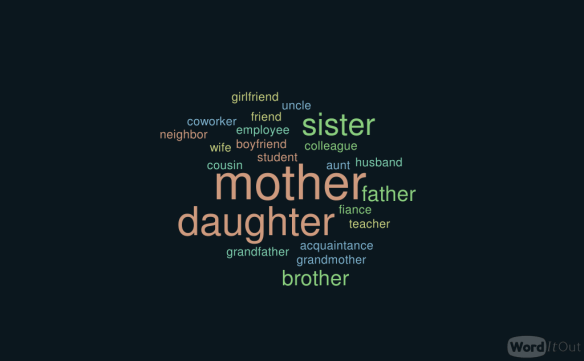
Relationships define existence.
They define our place in the world.
Human being
Citizen
Colleague
Employee
Friend
Child
Parent
Sibling
Spouse
We start out broadly, with terms defining our connections in a system.
But the deeper into familial structure we go, the terms become more specific:
Female/Male
Daughter/Son
Sister/Brother
Mother/Father
Wife/Husband
The most intimate relationships are described by gendered words. Those relationships have grounding in gender. So a mother/son relationship is different from a mother/daughter relationship, even though both are parent/child. A sister/sister relationship is different from a brother/brother, or sister/brother relationship, even though they are all sibling relationships.
In response to my recent post on Third Gender, a friend of mine said, “The current popular thought on gender is that the binary definition is cultural. But what I see in the post is that all of the cultures listed showed a pretty strong acceptance of that definition. What was variable was whether or not they accepted an alternative gender expression, and how that alternative expression looked. That would indicate to me that the binary definition is the universally true one, and the allowance for alternative gender expressions is really the cultural one.”
Culturally, going back to ancient times, one’s natal gender impacted familial relationships and roles and responsibilities. There were those who lived outside of those cultural norms, and they have been met with varying degrees of acceptance and welcome. Even in those who didn’t conform to expectations, they are referred to as female-bodied, male-bodied, or intersex. They weren’t an entirely third entity, just redefined relationally to the binary.
Today, when those who don’t identify with their birth sex opt to change names and pronouns to reflect their sense or feeling, it impacts all of their relationships, with those at the core of family most impacted. It isn’t just a simple thing to flip a switch one day from having a daughter, to another day having a son. Each are equally valuable, and one can adapt to all kinds of change, but it isn’t simple. It is complex, with those strands of change woven throughout the whole fabric of family and probably of society as well.
If gender were just a social construct, why has it been so universally accepted as far back in history as we have record? If gender is a social construct, wouldn’t we see more diversity in how gender is defined in various cultures, rather than just differences in gender stereotypes? If it is just a social construct, then what do we do with our differences that are based on our biology and physiology? If it is a social construct, and one that does not serve the greater good, why don’t we tear it down, not just for a small percentage of people, but for everyone?
“Blank Slate” Parenting is a blog entry by a licensed clinical social worker who focuses on gender non-conforming and transgender clients. She suggests that “blank slate parenting is the ability for a parent to enter into parenthood without too many assumptions and expectations.” On the surface, that sounds good to me. It is often assumptions and expectations that cause dissatisfaction and undue stress. However, moving on in the post, she says, “Imagine how much easier it would be if parents understood not to get too attached to the sex of their child at birth! What if parents learned to ask ‘Do you feel like a boy or a girl? Both? Or neither?’ instead of telling the child who they are based on anatomy?”
There is much in what she says that resonates with me. I think we put too many cultural only expectations on one’s gender. I do think there is a broad range of expression and diversity within gender that should be encouraged. But the thought of questioning one’s child about whether they feel male or female or neither or both, seems unrelated to biological, physiological fact. To me, the questions should be more along the lines of how do you feel and how do you want to express that? What does it mean to be a boy or a girl? How do you want to define your experience?


You must be logged in to post a comment.