I have a small porcelain dish that used to belong to my maternal grandmother. 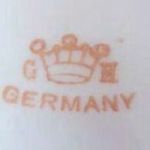 It is pearlescent white with three dusty pink roses and pale green leaves on the front. It has a scalloped top edge and a short pedestal base. On the underside is a stamp of the word Germany with a golden crown above it, a G to its left, and an H to its right. Greiner & Herda, a porcelain decoration studio in Oberkotzau, Germany opened in 1886. This stamp is one of their earliest markings.
Chips in the porcelain encircle the pedestal base. There is a sticky patch on the bottom from where an old bit of masking tape had been. My name was written in my grandmother’s handwriting on that tape. There is a crack through the entire piece just right of the center that has been glued. The adhesive has turned brown as the dish has aged over the years.
This dish has seen probably more than 120 years of life and traveled across continents and oceans. It is broken, chipped, and stained. But it is beautiful and precious. Its brokenness adds to its worth.
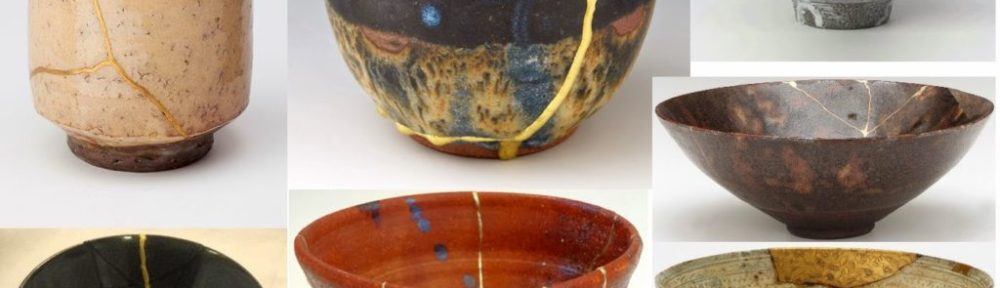
Kintsugi, which means “golden patch,” is a Japanese art form for repairing broken pottery.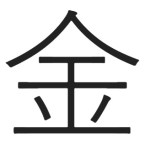
Kin = golden
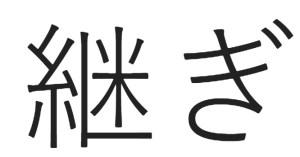
Tsugi = patch
They take pottery repair far beyond the adhesive fix on my grandmother’s dish. The kintsugi method uses lacquer that is then dusted or mixed with powdered gold, platinum, or silver. Sometimes broken vases, bowls, or teapots are redeemed through joining the fragmented pieces together with thin lines of the metallic lacquer. Other times, shards are completely missing and replaced entirely with gold compound or restored with replacement ceramic pieces connected by liquid metal in a patchwork fashion.
Kintsugi emphasizes imperfections and visualizes repairs and seams as something to celebrate.
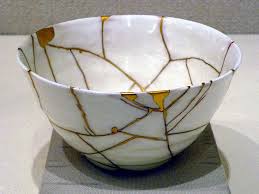
Modern artists experiment with the ancient technique as a means of analyzing the idea of loss, synthesis, and improvement through destruction and repair or rebirth.
http://www.perart.it/kintsugi.html
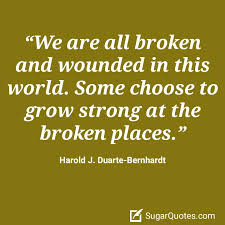
Kintsugi is also a life philosophy that does not consider the flawed and imperfect as something to disguise but to embrace. It values the marks of wear and age. It reminds us of the ways we are uniquely broken, testifying to our history, our resilience, our transformation.
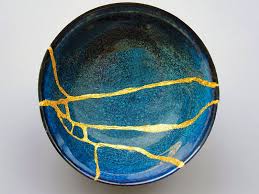 When restoring great works of art, attempts are made to make repairs invisible so it appears that nothing was ever damaged. But kintsugi allows our past experiences to inform our present. It celebrates who we have become because of our wounds, our rough edges, our broken experiences.
Rather than our wounds being only destructive, the moment we realize they are also constructive, we cross the threshold from the impossible to the possible. The moment we do this we are on the way to transforming what is broken into what is beautiful.
From “Broken to Beautiful: The Power of Kintsugi” by Val Jon Farris on HuffingtonPost.com
Today I am broken. I have been impacted by life’s journey in painful ways. Fragments of me are waiting for the beauty of golden lacquer to repair my brokenness. I am learning to embrace the things that have caused harm and bring them into the light to sparkle and shine and give depth to my patina. My wounds are uniquely mine and part of what make me a singular piece.
Jan 31, 2018
By Jorge Palileo on HelloPoetry.com
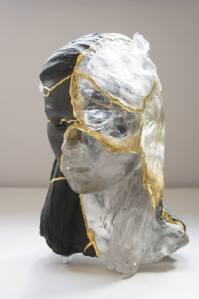
She is made
up of broken
bits and pieces,
held together
delicately by
her golden scars.
And that, my friend,
is what made
her beautiful.


You must be logged in to post a comment.