
Three Days Sober

3 days soberIn substance abuse programs, celebrating sobriety birthdays or benchmarks is considered important to serve as a reminder of the progress and growth one experiences through the recovery process.

I have not had a substance abuse problem, nor have I been in a substance abuse recovery program. However, coming out from under guilt-ridden faulty source beliefs is a recovery process all its own.

Last week, at the end of one day, I realized I hadn’t heard a guilty, attacking voice in my head all day. Two more days passed. At the end of the third day, I was surprised to discover that the voice had been quiet for three whole days. It hadn’t just been suppressed because I was telling it to go away. It was just silent.

It was at that moment I felt like celebrating my “three days sober.” It seems like an apt comparison. I am actively removing something in my life that I had felt was there to help me but was really destructive and full of negative power. I am seeking outside support to gain tools and resources for replacing the voice with mindfulness and critical thinking. I am developing and renewing friendships that reinforce the truth of challenge in all of our lives while at the same time providing space for encouragement and acceptance. Continue reading →
Stuart’s Cape

Our family of five has lived in three homes in three different states in the 19 years since the twins were born. This has meant being either far away or very far away from extended family at different points in time. In order to see them, travel was a necessity. Travel by airplane is an expensive proposition, and when you take the cost of a flight times five, it’s highly impractical, so the travel method of choice for our family was road tripping.

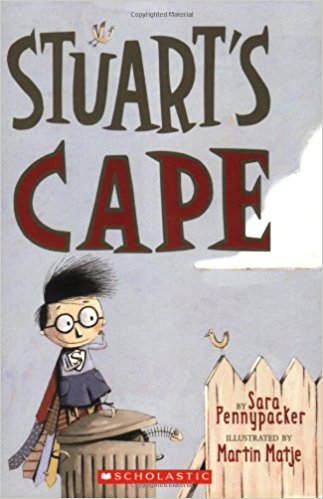
Stuart's capeSeemingly endless road trips are not the joy of most small children, so to make the trips more bearable, we often listened to books on tape while we traveled. What a difference that made! An all-time favorite is a book from 2002 by Sara Pennypacker called Stuart’s Cape. Goodreads summarizes it like this: A quirky, inventive chapter book featuring an unusual hero – an 8-year-old worrier.

At the start of the story, we find that Stuart wants to have an adventure. Because his family just moved to a new town, his packed-up box of toys mistakenly got picked up with the garbage, and he doesn’t have any friends yet, Stuart has to get creative. While conceiving adventure by imagining becoming a superhero, Stuart determines that adventures only happen to people in capes. He creates his own cape out of items all found in a box in the hallway labeled Stuff from Great Uncle Nester’s Magic Act. With the rusty stapler he discovered, Stuart fastened together all one-hundred ties he found along with a lone purple sock stapled inside to create a secret pocket. Best cape ever. Continue reading →

məˈCHo͝orədē = Maturity

Maturity = The state, fact, or period of being mature

Mature = Fully developed, full-grown

(Latin) Maturus = Timely, Ripe


In psychology, maturity is the ability to respond to the environment in an appropriate manner. Maturity also encompasses being aware of the correct time and location to behave and knowing when to act, according to the circumstances and the culture of the society one lives in.

Wechsler, David “Intellectual Development and Psychological Maturity”

Child Development, Vol. 21, No. 1, March 1, 1950 Continue reading →

Source Beliefs

Most of us have heard that a child’s formative years play a key role in their cognitive, social, emotional, and physical growth and their ability to achieve their full developmental potential. The World Health Organization (WHO) affirms that nurturing care is at the heart of children’s potential to develop, while the United Nations Children’s Fund (UNICEF) states that during the years of early childhood (0-8 years old) “a child’s newly developing brain is highly plastic and responsive to change as billions of integrated neural circuits are established through the interaction of genetics, environment, and experience. Optimal brain development requires a stimulating environment, adequate nutrients, and social interaction with attentive caregivers.” Continue reading →

Social Contagion, Part 2

“Rapid-Onset Gender Dysphoria” is described as occurring mostly in girls in their teens and early 20s who come out as transgender “out of the blue” without any childhood history of experiencing discomfort with their natal sex. Dr. Michael Bailey, Ph.D., psychologist and professor at Northwestern University, says, “We think this is an entirely distinct phenomenon from childhood-onset gender dysphoria. Indeed, we think it didn’t exist until recently. It is a socially contagious phenomenon, reminiscent of the multiple personality disorder epidemic of the 1990s.” Continue reading →

Gender Slider

Temperature Slider

Do you remember the climate control panel in older cars? The slider could move all the way to the blue side for completely cool air, and all the way to the red side for completely warm air. In the middle, the red and blue colors overlapped giving you a combination of hot and cold air. You could mix it just right to generate your optimal air temperature – directly in the middle for an equal mix, or slightly to one side or the other for a warmer or cooler effect on the air flow. Continue reading →

Live and let live

live and let liveLive and let live is a proverb that embodies tolerance, even without agreement.

We recently had a wonderful dinner and heartfelt conversation with friends who described their church as “live and let live” in ideology. They attend a United Methodist Church that has embraced being a reconciling congregation. It is a part of the UMC’s Reconciling Ministries Network whose guiding principles in part state: Continue reading →

What Not to Do

At the age of 13, our younger twin wrote us a letter expressing their convictions about being transgender. This twin struggled to express themself verbally, but always had a knack for writing. So a letter was their chosen method of communicating the big news.

At that time, I was still very certain of my conservative faith and view of the world, and I believed that a faithful reading of the Bible and commitment to things of faith would solve any problem that presented itself. I just needed to be strong and faithful, and persuade others to do the same.

Were I to do that time of life over again, I think and hope I would do it much differently. A retrospective look provides some clues of things not to do:

what not to do

  • Don’t speak your opinion so readily. Rather, ask questions, ask questions, ask questions.
  • Don’t attempt to handle all the moments at once. Only deal with the one in which you currently find yourself. Don’t play out all the possible scenarios.
  • Don’t belittle the opinions and feelings of a child, even in your own mind. Don’t assume they have no idea what they’re talking about.
  • Don’t think that your way of viewing the world, life, faith….is the only valid one.
  • Don’t assume you know the results of learning before you do the learning.
  • Don’t allow your emotions to control you, but also don’t invalidate any of your emotions because they all provide perspective and are valuable and real.
  • Don’t keep everything to yourself because you’re afraid of how people will respond.

Continue reading →