social contagion n.
The spread of ideas, attitudes, or behaviour patterns in a group through imitation and conformity. Also called behavioural contagion. …
from OxfordReference.com
In the college sociology textbook, Collective Behavior, by David A Locher, originally published in 2002, the second chapter is titled, “Social Contagion,” wherein we discover the origins of the naming of this psychological theory:
“The first modern theory of collective behavior used contagion to describe the transmission of thoughts, ideas, or behavior from one individual to an entire group of people. Contagion theorists refined the concept, using the slightly more specific term ‘social contagion’ to refer to this process.”
The original theory of social contagion is akin to crowd or mob psychology. The idea is that when people in a crowd focus their attention on the same event, person, or thing, they begin to influence each other’s behavior. Their moods and thoughts become contagious and can cause people within the group to do irrational and illogical things that they would not normally do.
Social contagion is a concept that has also been applied outside of crowd psychology into the everyday impact of how our social networks influence thoughts, moods, and behaviors. Dr. James Fowler, Ph.D., an American social scientist, co-authored a study with a colleague about the social spread of obesity which was published in the New England Journal of Medicine in July, 2007. Dr. Fowler recaps his findings in a 3-minute video on youtube on CBS News Only on the Web:
“Social contagion actually may account for as much, or perhaps, even more of a person’s risk of obesity than genetic and other factors that have been previously studied.
Academic research shows that, at least in the American population, and maybe in the international population as well, that we are all connected to one another by six degrees of separation. Your friends’ friends’ friends’ friends’ friends’ friend, for example, is going to include just about everybody in the population. And what we find, remarkably in the study, is that although the average degree of separation between individuals is six, here your influence extends up to three degrees of separation. And so, halfway, pretty much half the distance into the social network, your health behavior is having an impact on other people.”
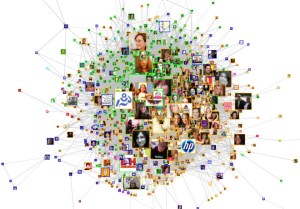 More recently, social contagion as a theory has been applied to the effects of the internet and specifically social media platforms like Tumblr, Reddit, Facebook, and Twitter, to name only some of the most well-known options. “The Simple Rules of Social Contagion” is a scholarly report (found on the National Center for Biotechnology Information site) that addresses the spread of information via social media. The whole report is pretty complex, and I admit much of it is beyond my comprehension, but the gist of the idea is that:
“Social media has revolutionized how people create and consume information. Unlike the broadcasts of traditional media, which are passively consumed, social media depends on users to deliberately propagate the information they receive to their social contacts. This process, called social contagion, can amplify the spread of information in a social network. Understanding the mechanics of social contagion is crucial to many applications: creating viral marketing campaigns, evaluating the quality of information, and predicting how far it will spread.”
I was recently reading an article in Family Circle magazine, “Storm Warning,” about processing information wisely and teaching our children to think critically about what ‘news’ they ingest. The author reminded us that,
“…digital and social media are inherently different forms of communication from their predecessors, and we’ve had only a decade to adjust – and even less time to adapt to the rise of social media and its influence over our news consumption. The intersection of these two massive forces is producing powerful effects that, at least so far, are making it difficult to fully trust the information we’re exposed to day in and day out.”
I don’t know what impact social contagion has on individual choices of identity, personal feelings of well-being, and influence towards choices one might not otherwise make or even be exposed to. I do know we’re creatures that thrive on community, so any method of communication that brings people and ideas together socially will have an impact on the population. That impact may include both positive and negative results, but there will be impact.
My twins were allowed to purchase tablet computers with internet access back in seventh grade. That was the year that our first twin came out to us as transgender. I’m sure that does not mean that it is because of the internet that they “out of the blue” chose to identify as transgender. However, having access to that resource, which includes all types of information ranging from highly-reliable fact to a broad representation of personal opinion and experience, likely contributed to them considering thoughts and ideas to which they had previously been unexposed. Because pre-teens and teens are more suggestible and susceptible to questionable concepts, and they lack critical thinking skills and experience, it seems plausible that some level of social contagion has been at play in the ensuing years and decisions made.
There are other families in similar situations to ours where their teen and early 20’s daughters have come out as transgender in higher percentages than has been documented in the past. One theory behind this trend has been called “Rapid Onset Gender Dysphoria.” In Social Contagion, Part 2, which will post next Wednesday, I’ll look further into this specific type of posited social contagion.


You must be logged in to post a comment.