Most people in my circles would assume that there are only two genders and there’s nothing more to think about. Case closed. Maybe that’s what I think – thought? – too.
Gender has come to refer to the social and cultural roles that tend to be associated with one or the other biological sexes and is no longer considered synonymous with physical sex.
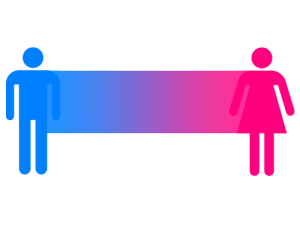 But even before the meanings of gender and sex diverged, there have existed terms for people not fully male or fully female, as in Mesopotamian mythology, or from inscribed Egyptian pottery shards from 2000 BCE that list three genders: tai (male), hmt (female), and sḫt (sekhet). Sḫt is often translated as “eunuch”, although there is little evidence that such individuals were castrated.
Sacred texts from India’s three ancient spiritual traditions refer to a third sex. They describe individuals as belonging to one of three categories, based on their nature, which they call prakrti. The three natures are: pums-prakrti (male nature), stri-prakrti (female nature), and tritriya-prakrti (third nature). Texts from these traditions indicate that third sex people were common in that time and could be female-bodied or male-bodied or intersex.
Within the Buddhist writings of the Vinaya, the term pandaka referred to a broad category of intersex individuals as well as male- or female-bodied people who were characterized by physical or behavioral attributes that were not considered consistent with the natural characteristics of men and women.
There are even Biblical scholars who have argued that the eunuchs in the Hebrew Bible and the Christian New Testament were understood in their time to belong to a third gender.
The list of populations from times past to current day which refers to an additional gender category is much longer than anticipated, so I can’t share all that I’ve found. But here is a brief list of people groups, their countries of origin, and a descriptive note about each.
Hijra / India – This group consists of biological males living as females. They are recognized legally in India, Bangladesh, Pakistan, and other South Asian countries even when same-sex sexual relationships are illegal. They physically transition, tend to be outcasts, often turn to prostitution, live together as family, and use fashion as a way to express identity.
Femminielli / Naples, Italy – From his blog Naples: Life, Death, and Miracles, Jeff Matthews writes:
They were born in a squalid slum, bereft of air and light, into families where promiscuity is the rule and all the children generally sleep in one bed…he is usually the youngest male child, ‘mother’s little darling,’ and tends to imitate his mother’s feminine sweetness…It is unusual for a poor family to view the femminiello as a family disgrace in any sense of the word; he is useful, he does chores, runs errands and watches the kids…and a mother would have no second thoughts about asking a femminiello to babysit.
Muxe / Mexico – This population, biological males that dress and act in typically female ways, is seen as a totally distinct group, unlike the western conceptualizations of gender spectrums and sexual preferences.
Burrnesha aka “The Albanian Sworn Virgins” / Albania – This is one of few groups of biological women considered third gender. After swearing an oath of celibacy, they were granted the right to live as men in all areas of life.
Yan Daudu / Nigeria – Yan Daudu means sons of Daudu, who was a fun-loving, gambling spirit that is worshipped in the Muslim Bori practice.
Kathoey / Thailand – Now used for all transgender identified individuals, this term historically referred to intersex people and meant one who was comprised of two genders at the same time.
Fakaleiti / Tonga – The Fakaleiti, who live on the island Tonga in the South Pacific Ocean, are males who behave in a relatively effeminate manner.
Mahu / Hawaii – Synonymous with Fakaleiti, Mahu means “in the middle.”
Fa’afafines / Samoa – Fa’afafines is a compound word where “fa’a” means “in the manner of” and “fafine” means “woman.” It is traditional that if a family had more boys than girls or not enough girls to help with women’s duties, male children would be chosen to be raised as fa’afafine.
Female husbands / Africa – Biological females take on the traditional roles of men by becoming the sociological husband of another woman. Different than lesbianism, the women create a familial bond but generally are freed to have multiple and anonymous male partners.
Berdache “Two Spirit” / Native American – This tradition was usually practiced strictly by males. In only 30 groups out of 150 tribes are there reports of female berdaches. From owlcation.com:
“Yet the berdache tradition played a vital role both in the tribe and at the individual level, allowing for expression of one’s preferred way of life without dictating sexuality.”
Because a third sex existed in history doesn’t speak to it being right or wrong, it just indicates that it is a real experience and has been a part of culture for a long time. It probably means we need to give some thought to this occurrence in life and how we should respond.
It’s fascinating to think that ancient people groups didn’t see themselves as nicely divided into two distinct categories but allowed room for a broader expression. Also interesting to note, it was most often biological males who were chosen or chose to live in an alternate role. In many cultures, the reason behind the choice (needing more female help around the house) or the results of the choice (prostitution), don’t seem very healthful. It does seem clear that fitting in to the expected roles for one’s biological sex has been an issue for a long time.
Joel Baum, Senior Director of Gender Spectrum in Berkeley, CA, expresses a perspective I appreciate: “So much of this now focuses on ‘trans issues’ when what we really need to be talking about is gender diversity for everyone. What it means for you to be a guy or a girl or something else. A lot of times people think it’s just a question of switching the boxes.”


You must be logged in to post a comment.