Most of us have heard that a child’s formative years play a key role in their cognitive, social, emotional, and physical growth and their ability to achieve their full developmental potential. The World Health Organization (WHO) affirms that nurturing care is at the heart of children’s potential to develop, while the United Nations Children’s Fund (UNICEF) states that during the years of early childhood (0-8 years old) “a child’s newly developing brain is highly plastic and responsive to change as billions of integrated neural circuits are established through the interaction of genetics, environment, and experience. Optimal brain development requires a stimulating environment, adequate nutrients, and social interaction with attentive caregivers.”
Recently I was privileged to go to a conference for special education teachers and administrators where I attended a session entitled, “Compassion Fatigue: How to Prioritize Self-Care without the Onset of Guilt,” which was presented by nationally recognized wellness expert, Bizzie Gold. Foundational to her method of promoting self-care, she explained how our early childhood experiences not only affect our developmental potential, but impact our daily interactions and decisions as adults as well. Built on biochemical patterns, our decision-making tends to function on autopilot based on operating beliefs and culture passed on over the course of our lives.

Bizzie explains that the emotions we experienced with high frequency as children aged 0-15 stimulate biofeedback that causes emotional addiction. This is easily understandable for those who experienced traumatic childhoods, but she notes that it is also often true for those with “good” childhoods, too, since children cannot easily analyze emotions and responses. The patterns of emotional addiction become hardwired into your body between the ages of 8-15, yet most of us have no idea they are the primary decision-making source for our beliefs, behavior, and choices.
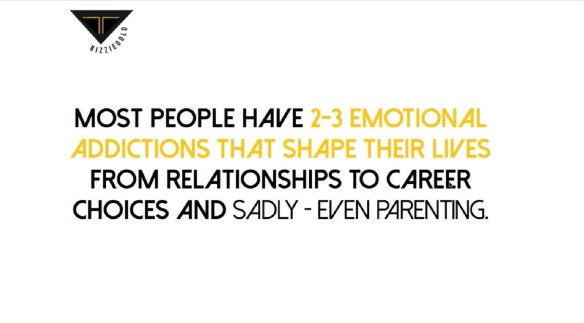
These emotional addictions all start with the formation of a belief. Our brains receive sensory stimuli and must assign meaning. The brain defines the sensory input, and that definition becomes the new standard operating procedure, or belief. That belief then defines our possibilities, goals, and actions. The standard operating procedure that is created blocks possibilities, thoughts, or actions that go against the source belief. If other possibilities, thoughts, or actions do make it through, they cause us to feel guilt.
It’s important for us to realize that this is how our brains work, so that we can step back and figure out who helped place our source beliefs and why, and how we should respond more analytically in the future, to challenge source beliefs that might not be accurate or serving us well.
Bizzie’s list of the five most common source beliefs includes:
- I have to hold it all together for everyone / I have to be the peacekeeper

- Everyone abandons me / I will always be rejected
- I’m not enough / I’m a disappointment
- I have to be in control to be safe (or to be loved) / I am not safe
- Life is chaos and/or has no meaning
Bizzie continued discussing the typical scenarios that create the different source beliefs and ways to retrain our reactions to change the stimulus/response patterns developed and replace them with healthy models that allow us to see ourselves and others more honestly.
The two source beliefs that resonated with me most were 1) that everyone abandons me and 2) that I have to be in control to be loved. These beliefs make sense of how I’ve interacted with my world for fifty years: always needing affirmation and assurances, assuming that people won’t understand or like me, working hard to always have a plan and not be taken by surprise.
My counselor recently shared her observation that I am always very hard on myself, and that it appeared no one had ever helped me learn to organize my emotions. She and I discussed the impact of the death of my younger brother when I was three years old. I had become aware that this played a role in my story back in my developmental psych class in college, and more recently I’ve been discovering the depth of its impact as I’ve been doing soul-searching about life, family, and faith. The counselor explained that she saw further impact on my story, including the year of my mother’s pregnancy preceding the birth of my brother who died, the nine months of his illness, the period of my parents’ grieving following his death, and then my mother’s pregnancy with my youngest brother only a couple years later. At least the first six years of my life were affected.
Guilt has been a voice in my head for as long as I can remember, just like Bizzie suggests will happen when we have thoughts and ideas that challenge our source beliefs. Every time I feel good about something, I have thoughts that attack me and tell me that I’m not truly good, or not truly worthy, or that somehow I’m not real or honest with myself and others. I have believed this voice to be my conscience, so would alternately feel determined to conquer the negatives by being better and trying harder, or feel beaten down by failing yet again.
Now I know that voice is not mine. It is a voice from the past following ingrained patterns of the brain that were formed through a child’s inaccurate assessment of circumstances. A friend recently asked me what I would do if someone actually spoke to me the way this voice does. I emphatically declared that I wouldn’t allow it, and would strongly speak out against them. He suggested that I use that approach on this voice. I am learning. 🙂 I am committed to being gracious to myself to facilitate growth and healing. I pray that my children will unearth their source beliefs much sooner in their lives, and that I can be a part of bringing about their growth and healing as well.


You must be logged in to post a comment.