
Our family of five has lived in three homes in three different states in the 19 years since the twins were born. This has meant being either far away or very far away from extended family at different points in time. In order to see them, travel was a necessity. Travel by airplane is an expensive proposition, and when you take the cost of a flight times five, it’s highly impractical, so the travel method of choice for our family was road tripping.
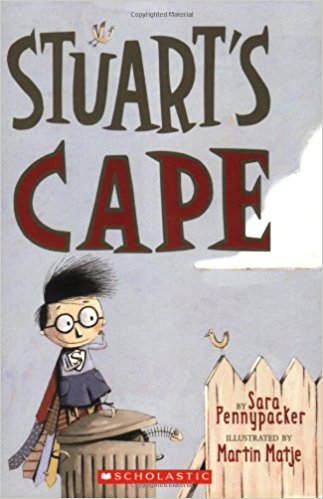 Seemingly endless road trips are not the joy of most small children, so to make the trips more bearable, we often listened to books on tape while we traveled. What a difference that made! An all-time favorite is a book from 2002 by Sara Pennypacker called Stuart’s Cape. Goodreads summarizes it like this: A quirky, inventive chapter book featuring an unusual hero – an 8-year-old worrier.
At the start of the story, we find that Stuart wants to have an adventure. Because his family just moved to a new town, his packed-up box of toys mistakenly got picked up with the garbage, and he doesn’t have any friends yet, Stuart has to get creative. While conceiving adventure by imagining becoming a superhero, Stuart determines that adventures only happen to people in capes. He creates his own cape out of items all found in a box in the hallway labeled Stuff from Great Uncle Nester’s Magic Act. With the rusty stapler he discovered, Stuart fastened together all one-hundred ties he found along with a lone purple sock stapled inside to create a secret pocket. Best cape ever.
There are many fun lessons to learn from Stuart’s adventures. First of all, “people with capes never act surprised.” Stuart’s cape helped him stay calm even in unusual circumstances.
We all often wear “capes” in our everyday lives. Perhaps the cape is a certain style of dress, a persona we present, routines we apply to our mornings or to when we first arrive at our place of work. Whatever our cape is, it empowers us to go beyond our own feelings of insecurity and push out of our comfort zone.
Day two of Stuart’s cape adventures resulted in him gaining the ability to fly. He used his imagination to enjoy this new power to its fullest. “Stuart was so busy he forgot to feel lonely. He could do anything.”
We learn that being creative and active can help us overcome loneliness and increase feelings of empowerment and value. Rather than sitting idly wishing for change, we can wear our capes and find adventure.
My favorite part of the book is Stuart’s third adventure day, where he grows toast from magic seeds he found in the cape’s pocket. Stuart makes a list where he describes all the reasons why he likes toast.
- It’s warm
- You can put stuff on it
- Stays where you put it because it is not slimy
- Smells good
- Fits in your pocket
Descriptions help us understand the perspectives of others. They help us to be specific about what something is, or how we see it, so someone else can engage our ideas and understand where we’re coming from, or share a differing viewpoint.
Adventure day number four was New Student Orientation Day at Stuart’s new school. It was like having an extra first day, one more day to be worried about. He was pleased when he realized that with his cape, he could face the worries head on. To his dismay, his parents wouldn’t allow him to wear his cape to school. It was bad enough he didn’t have a friend, now he had to face the day without his cape. He felt weak.
Sometimes we struggle to tackle new situations when we don’t have our security capes. We feel small and inadequate, like Stuart did. Maybe there is a way for us to use our creativity and imagine ourselves in capes even when their protective coverage is unavailable. The power of the cape is really in our own minds.
Stuart misses all but the very end of his New Student Orientation Day because he put his cape back on and drove around the neighborhood collecting trash in an unattended garbage truck he found.
Eventually, he discovered that his cat, One Tooth, and the trash collector, Stanley, had accidentally switched bodies through the magic of his cape. Stuart saved the day by changing them back. Stanley was distressed because he had missed his day of work, but Stuart reassured him that he had done the collection for Stanley. Stanley explained that trash collecting wasn’t his work, it was just his job. He then showed Stuart a barn full of useful things he had salvaged from his trash collecting job and said,
“People throw great stuff away all the time. They think it’s junk because it’s old or broken a little. Maybe they don’t see how great it could be. Maybe they’re too busy to fix it. Anyway, saving it is my work.”
That might not always be a great attitude towards trash, though some of the useful items might really turn out to be of service, but as an attitude towards people and relationships, it’s of great value. Some people are old and broken, but still have potential for greatness. Relationships take time and sometimes people are too busy to fix them. With care and tenderness, however, perhaps we can see the value in people and relationships that are old, broken, and require work.
Stuart’s Cape is a fun story, full of entertaining characters including One Tooth, Stanley the trash collector, and even Stuart’s Aunt Bubbles. (You’ll have to read it for yourself to enjoy her escapades.) Beyond the fun, though, there’s much wisdom to gain.
 I love the lens of greatness the trash collector applies to the unwanted items thrown away by others. My desire is to apply that lens to how I view my own brokenness and the relationships with my children that need fixing.


You must be logged in to post a comment.